How to Read Council Agendas and Minutes for Local Issues
Learn how to read council agendas and minutes to trace a local issue, locate the papers behind it and identify what to ask the council next.
If a council agenda lists a new residents’ parking scheme, it tells you the proposal is scheduled for discussion; council minutes tell you what the published record says happened at the meeting. To follow the issue beyond that point, you may need the report, a later committee paper or an update from the council team responsible.
Think of an agenda as the label on a folder and minutes as a note added after the meeting. The label points to the papers inside, but it cannot tell you what members did with them.
Which documents trace a local issue?
Start with the question you need answered. Are you looking for background to a proposal, the meeting where it was considered, or a later update about the council’s work? Each calls for a different record.
- If you need the proposal’s background, check the agenda report and attachments; if they do not explain the context you need, look for earlier reports or ask the council where the supporting papers are held.
- If you need to identify the meeting, check the agenda’s date and committee name; if the issue is not listed, search other relevant committees or later agendas rather than assuming it was never considered.
- If you need what the meeting recorded, check the matching minutes; if they are marked as a draft, look for a later approved version before treating the wording as settled.
- If you need the precise wording of an action, check for a resolution or linked decision notice; if neither is published, ask the council which record contains the operative wording.
- If you need to know what happened afterwards, check later papers or a service update; if none appears, ask the responsible team whether the action has been completed or is still in progress.
- If you need to understand a change between proposal and outcome, compare the report’s options with the minutes; if the reason remains unclear, ask whether a further report or decision record explains it.
This approach keeps separate the proposal, the record of the meeting and later work. They are related parts of one issue, but one document may not answer all three questions.
What can an agenda tell you?
An agenda identifies business scheduled for a particular meeting. It commonly gives the meeting details and item titles, with links to reports, appendices or other papers.
Those papers can explain a proposal, describe options and set out a recommendation. Read the report as well as the agenda heading: a short title may not make clear what members are being asked to consider.
An agenda is not evidence that an item was reached or that a recommendation was adopted. It shows what was planned, not whether members postponed the item, asked for more work or took another course.
What can minutes tell you?
Minutes are the council’s published account of what took place at a meeting. They may record who attended, the business considered and any action or decision, but they are usually a summary rather than a transcript.
Look for clear wording about the outcome. A note that members discussed a proposal does not by itself say what they decided. A recommendation in a report describes what its author suggests; the minutes or a separate decision record are the places to check for the body’s recorded action.
Check whether the minutes are labelled draft, unconfirmed or approved. If you find a draft, search for a later version or the minutes of a subsequent meeting that confirm them. A concise entry may still leave the reasoning or the exact discussion unstated.
How do you trace a council issue through its records?
Match each document to the same committee, meeting date and item. Similar titles can appear in different meetings, so check those details before drawing a link between a report and a minute entry.
Then compare the report’s request or recommendation with the minutes’ account of the outcome. If the records point to further work, search later agendas for the item or a related report. For follow-through, look for a service update or contact the team named in the papers.
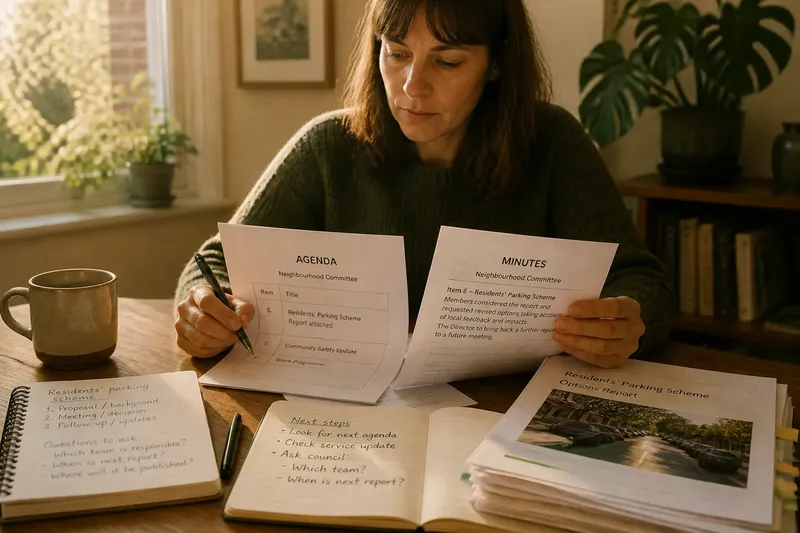
Say you are following a proposed residents’ parking scheme. Imagine the agenda links to a report asking a neighbourhood committee to consider collecting more information; after the meeting, the minutes say members requested revised options. You check the next relevant agenda and find a new report setting out those options. Taken together, those records would show that further work was requested and later reported, but not that the scheme was introduced.
Keep a note of which record supports each point. That makes it easier to distinguish what the council planned, what the meeting recorded and what a later update says happened.
What should you search for when a record is unclear?
Where can I find the report attached to an agenda?
Open the agenda item and follow its links to reports or appendices. If a link is missing or broken, contact the council with the meeting date, committee name and item title.
How can I tell whether minutes are approved?
Check the document label and any later meeting papers that confirm the record. If its status remains unclear, ask the council whether the minutes are draft or approved.
Where can I find out what happened after a meeting?
Search later agendas, committee papers and updates from the service named in the record. If no update is published, ask the responsible council team whether there is a current status or next step.
What if two records seem to say different things?
Check that they concern the same meeting and distinguish a report’s recommendation from the later recorded outcome. If the apparent conflict remains, ask the council to clarify the specific wording and point you to any separate decision record.
When should you contact the council?
Ask when the published papers leave out a detail that matters to your understanding, such as the status of draft minutes, the location of a resolution or the expected next update. Identify the meeting and item, then state what you could not establish from the records.
If the minutes say a parking proposal was referred for further work, for instance, you could ask which team is responsible for the next report and where it will be published. That is more focused than asking generally what happened, and it does not assume the scheme was approved or rejected.
If you are considering a formal complaint or legal action, published records can help you identify relevant documents, but they may not answer questions about your particular position. Consider getting advice from a qualified professional where the consequences matter.
For council agendas and minutes, follow the trail from the report to the meeting record and then to any later update. If a link in that trail is missing, the meeting date, committee and item title give you a clear starting point for asking the council what to consult next.