What to Listen for at Your First Neighbourhood Forum
Learn what to listen for at a neighbourhood forum: separate concerns from solutions, spot unanswered questions and leave knowing who will follow up.
At your first neighbourhood forum, you can leave with a clear sense of what was discussed without speaking once. Listen for how a concern is described, whether a response is being requested or proposed, and what—if anything—the group agrees to do next.
What does a neighbourhood forum meeting sound like?
One agenda item might bring a short report, a resident’s concern and a few questions from the room. The conversation can move between planned business and informal discussion, so you do not need to capture every sentence; follow one topic from the concern to its outcome.
Issues might involve a street, shared space, community activity or local service. The forum may be able to discuss or refer a matter, while a council team, service provider or other body handles the decision. Notice who is being asked to respond and whether the forum itself has agreed to act.
How do I separate a concern from a proposed solution?
Listen for three distinct things: what someone observed, what they are asking for and what they think might solve it. “The path is hard to use after dark” describes an experience; “could someone check the lighting?” is a request; “let’s add another lamp” is a proposed solution. Keeping them separate stops one suggestion from being mistaken for an agreed decision.
Specific details help the room understand a concern. A location, a description of when something happens and who is affected can make a point easier to follow. If those details are missing, someone may ask for clarification before the group discusses possible responses.
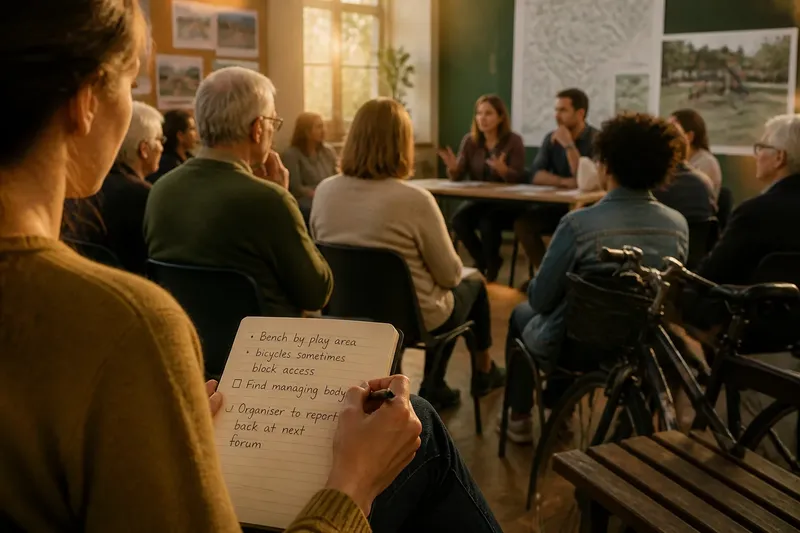
Say you attend a forum where a resident says bicycles often block a bench beside a play area. You note the location and concern, then hear the group ask when it happens and whether the resident wants the bicycles moved or a different arrangement. The resident asks the organiser to check who manages the space; if the organiser agrees to do so and report back, your note records that agreed enquiry—not a promise that the bench will be cleared.
How can I track questions and agreed actions?
Use one compact note for each topic: the concern, any unanswered question, and the action the meeting actually agreed to. Add the person or group responsible and how an update is expected to reach residents, if those details are given. A notebook or phone notes app is enough; think of each entry as a shopping list, not a transcript.
- If the speaker names a precise location, record it; if the location is unclear, note that detail is still needed before the issue can be followed up.
- If the account describes what happened and when, write those observations down; if it remains broad, record a request for a specific instance rather than guessing at the cause.
- If the speaker asks for an action, record the request separately; if no request is made, do not turn the observation into one on the speaker’s behalf.
- If someone suggests a fix, label it as a proposal; if the group has not agreed to it, keep other possible responses open.
- If a question is left unanswered, mark it as open; if someone accepts responsibility for checking, add that person or group and the stated route for an update.
- If the chair or group clearly agrees an action, record what will happen and who will take it forward; if the wording is tentative, mark it as a suggestion and ask for clarification later if useful.
- If an update date or meeting is named, note it; if none is given, record that the timing is unknown rather than implying a deadline.
For example, imagine your invented notes start with these details: the bench beside the play area, bicycles blocking it at busy times, a resident asking who manages the space, and no named contact yet. You separate the observed problem from the requested check, then hear the organiser agree to identify the managing body and bring back the answer at the next forum. Your resulting note is: “Bench by play area; bicycles sometimes block access; find managing body; organiser to report back at next forum.” The trade-off is clear: the group has agreed to find out who is responsible, but it has not agreed to move the bicycles or change the space.
What can I ask if the discussion is unclear?
You can ask a short question without offering a solution or taking over the conversation. “Has someone agreed to follow this up?” can clarify responsibility; “Where will the update be shared?” can make the next step easier to track.
If there is no time to discuss your question, ask the chair or organiser how residents can submit it or find a later update. Keep any follow-up specific: name the agenda topic and ask whether an answer or progress report is available.
What should I listen for at a neighbourhood forum?
How do I know whether an action was agreed?
Listen for a clear action and an identified person or group taking it forward. If the wording is “someone could look into it”, record a suggestion, not a settled commitment.
What if nobody answers a question?
Mark it as open and note whether anyone agrees to find out more. If no owner or route is mentioned, you can ask the organiser later who is best placed to respond.
Can I attend without speaking?
Yes. You can listen, take brief notes and decide for yourself whether to contribute at this meeting or another time.
How do I check what happened after the meeting?
Look for a forum email, notice or later meeting update, or ask the organiser where outcomes are shared. Describe the topic and ask whether an update is available, rather than assuming the proposed response went ahead.
How can I make sense of your notes afterwards?
Separate what you heard from what you inferred. “The group agreed to ask who manages the site” is not the same as “the site will be changed”; keeping that distinction in your notes makes it easier to describe the meeting fairly.
At your first neighbourhood forum, one well-recorded thread is more useful than a page of hurried remarks. If the issue returns, check your note for the open question, the agreed action and the person or group meant to follow up; that gives you a focused place to begin.